A radiator is a simple thing. Hot water goes in one end, gives up its heat to the room, and comes out cooler at the other. When one stops working properly, the fault is almost always in that flow - air where water should be, gunge where the water should run, or a valve that has stopped opening. You don't need to understand a boiler to fix most of it.
What follows are the faults a handyman gets called out for again and again, in plain terms, with the honest DIY-versus-pay line for each. One reassurance before you start: none of the jobs on this page touch the gas side of your system, so none of them legally need a Gas Safe engineer. The single hard limit - anything on the boiler itself - is spelled out at the end.
First, Read Where the Radiator Is Cold
Before you reach for a tool, put your hand on the radiator and work out the pattern. A cold radiator is not one problem, it is at least five, and where the cold patch sits usually tells you which one you've got. This one habit saves you bleeding a radiator that never had air in it.
| What you feel | Likely cause | What fixes it |
|---|---|---|
| Cold at the top, warm at the bottom | Trapped air | Bleed it (5-minute DIY) |
| Cold at the bottom, hot at the top | Sludge settled inside | Flush the radiator or the system |
| One radiator stone cold, the rest fine | Stuck valve pin (TRV) | Free the pin |
| Far-off rooms never quite catch up | System out of balance | Balance the radiators |
| A drip or damp patch by a valve | Leaking valve gland | Tighten or re-seal it |
| Every radiator cold | Boiler, pump, thermostat or pressure | Call a professional |
Notice the last row. When the whole house is cold, the radiators are innocent - the problem is upstream, and that is where DIY ends and a heating engineer begins. Everything above it is fair game.
How to Bleed a Radiator
Bleeding is the fix for the classic complaint: hot at the bottom, cold across the top. Air has collected in the highest part of the radiator and is sitting where hot water should be. Letting that air out is the easiest job in the house, and it is where most people start.
You need a radiator bleed key (a small square key, about £1 to £2 from any DIY shop) or, on many newer radiators, just a flat-blade screwdriver. Have an old cloth and a small container ready, because a little water follows the air out. Then, following the method British Gas and Worcester Bosch both set out:
- Turn the heating off and let the radiators cool. Bleeding a hot system means scalding water under pressure, so wait until the radiators are cold to the touch.
- Find the bleed valve. It is the small square peg at the top corner of the radiator, on one side - the bit your key or screwdriver slots onto.
- Open it a quarter to half a turn anti-clockwise. You'll hear a hiss - that's the air escaping. Hold the cloth under it.
- Close it as soon as water dribbles out steadily. The hiss stops and a thin trickle of water appears; that means the air is gone. Turn the valve back the other way to close it - firm, but don't force it.
- Work through the house in order. Do the downstairs radiators first, then upstairs, and within each floor start with the one furthest from the boiler. Air rises, so this bottom-to-top, far-to-near order clears the whole system properly.
One step people forget: check the boiler pressure afterwards. Letting water out drops the pressure, and if the gauge reads below about 1 bar when the system is cold, top it back up to between 1.0 and 1.5 bar using the filling loop (the little braided hose under the boiler). If you bleed a radiator and it fills with air again within a few weeks, stop bleeding it on repeat - air getting in that fast points to a fault worth a proper look.
How to Balance Radiators
Here's a problem bleeding won't touch: the radiators near the boiler roast, and the ones at the far end of the house never really warm up, even though every one of them has been bled and none is cold at the bottom. That is a system that needs balancing - sharing the hot water out evenly instead of letting the nearest radiators grab it all.
Balancing is done at the lockshield valve, the plain valve at the opposite end of the radiator from the thermostatic one, usually hidden under a plastic cap. Throttling the lockshields on the greedy near radiators forces more flow to the starved far ones. As Ageas and Vaillant describe it, the method runs like this:
- Bleed every radiator first, then turn the heating off and let it all go cold.
- Open every valve fully, fire the heating up, and note the order in which the radiators warm - the ones nearest the boiler go first.
- Let it cool again, then start with that fastest radiator: close its lockshield fully, then open it about a quarter to half a turn.
- Using a thermometer on the pipe each side of the radiator, aim for roughly a 12 degree difference between the flow pipe going in and the return pipe coming out.
- Work outwards to the furthest radiator, opening each one's lockshield a little more than the last.
It is not hard, but it is fiddly and slow, and it wants a thermometer and some patience. Plenty of people do it themselves over an afternoon; plenty of others hand it to a handyman or heating engineer to sort in an hour or two. Either way it is worth doing, because a balanced system heats the whole house evenly and the boiler runs less to get there.
Radiator Cold at the Bottom: Sludge
A cold strip along the bottom of a radiator with a hot top is the mirror image of the air problem, and it has a different cause: sludge. Over years, the steel inside radiators corrodes, and the resulting rust and debris turns the system water black and settles as a heavy silt in the bottom of the radiators and pipework. It blocks the flow along the base, so the bottom stays stubbornly cold. Bleeding does nothing here, because there is no air to let out.
For a single affected radiator, it can sometimes be taken off the wall and flushed through outside with a hose - a messy job, but doable. When several radiators are cold at the bottom, the whole system is silted up and needs cleaning out. That usually means a power flush, where a pump pushes cleaning chemicals through every radiator and pipe to shift the sludge. According to Checkatrade and MyJobQuote, a power flush typically costs £300 to £600, and more for a big system, usually taking most of a day. To stop it coming back, a good engineer adds a corrosion inhibitor to the water and often fits a magnetic filter to catch debris before it settles.
When One Radiator Won't Heat Up at All
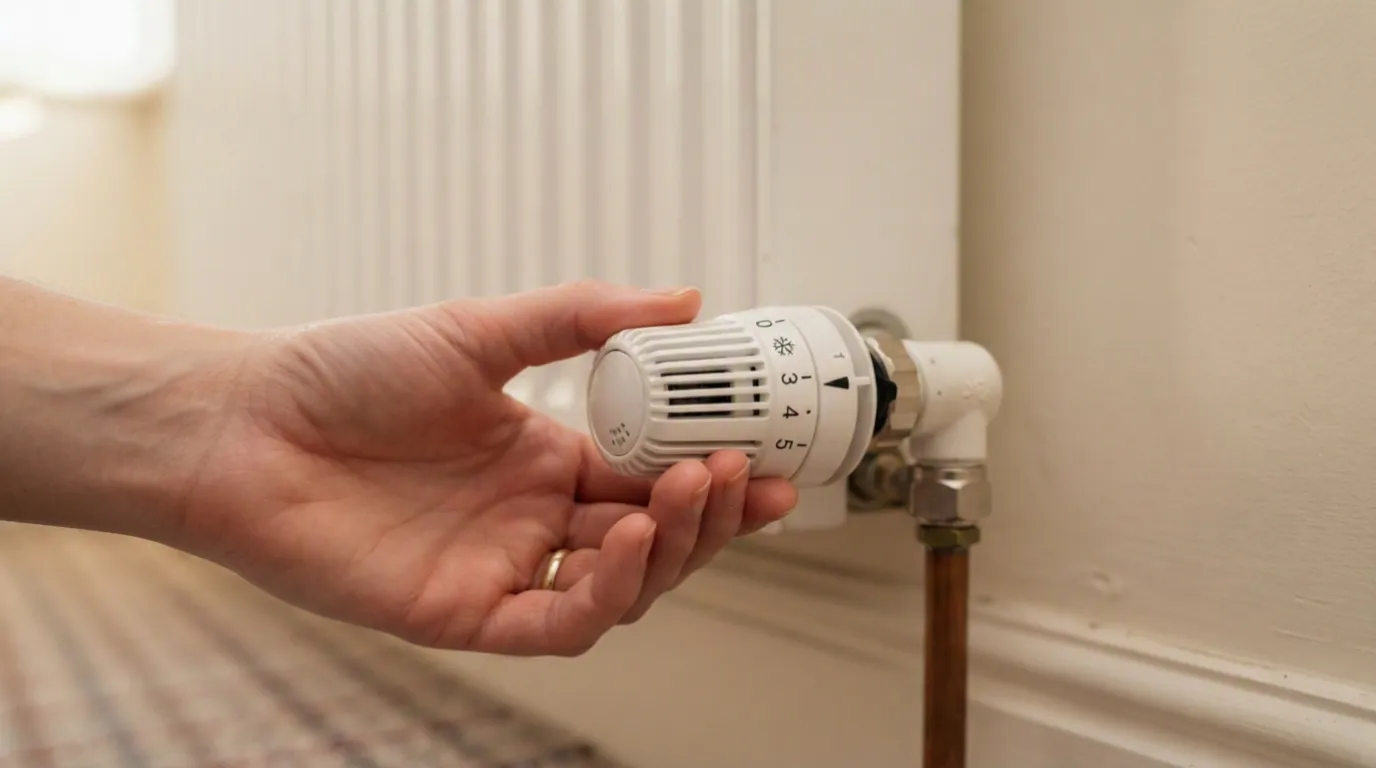
Different symptom, different fix: one radiator dead cold from top to bottom while every other radiator in the house is toasty. Nine times out of ten this is a stuck thermostatic radiator valve, or TRV - the numbered dial you turn to set a room's temperature. The pin inside it can seize in the closed position, most often after a summer of sitting unused, so the radiator never gets the signal to open.
There's a quick way to confirm it. Feel the pipe running into the radiator: if that pipe is hot but the radiator stays cold, hot water is arriving and the valve is refusing to let it in. To free it, as BestHeating and Trade Radiators explain, unscrew and lift off the TRV head to expose the small spring-loaded pin underneath, then gently work it up and down with your fingers or the back of a screwdriver until it moves freely. A squirt of penetrating oil (WD-40 or similar) helps a stubborn one. The trick to never doing this again: leave your TRVs turned fully open over the summer so the pins can't seize shut.
If it is not one radiator but all of them staying cold, the radiators are fine and the fault is with the boiler, the pump, the thermostat or low system pressure. That is where you stop and call a heating engineer rather than working through the rooms one by one.
Dripping Valves and Small Leaks
A small drip or a rusty damp patch under a valve is common and usually minor. The frequent culprit is the gland nut - the nut around the valve spindle where the head meets the body - working loose, or the washer inside it wearing out. As Radiators Direct notes, a gentle quarter-turn of the gland nut with an adjustable spanner stops many of these leaks, and if it doesn't, wrapping a little PTFE plumber's tape around the spindle thread usually seals it.
Know when to stop, though. If the valve body itself is cracked, the pipe is corroded, or the drip won't settle after you've tightened things, the valve needs replacing - and that means draining down that part of the system, which is the point to bring in a handyman or plumber rather than making a small leak into a soaked carpet. A slow weep can wait a day; a steady drip onto a wooden floor cannot.
What You Can Do Yourself, and When to Call a Pro
The reassuring bit first. Almost everything on this page is what the trade calls "wet work" - water, not gas - so it does not require a Gas Safe registered engineer. The Gas Safe Register is clear that gas registration covers gas appliances and pipework, and a non-registered person may carry out wet work such as fitting pipes and radiators. So a competent handyman can bleed, balance, free a stuck valve, cure a dripping gland and even swap a radiator like-for-like. The one hard line: any work on the gas boiler itself, and the final connection of the pipework to it, must be done by a Gas Safe engineer. Our guide to what a handyman can legally do sets out where that line sits across the whole home.
So when is it worth paying someone? When the job needs the system drained, when it's a whole-house issue rather than one radiator, or when the diagnosis is the hard part. Rough UK figures to budget against:
| Job | Typical cost | Who |
|---|---|---|
| Bleeding a radiator | Free (DIY) | You, in five minutes |
| Freeing a stuck TRV pin | Free (DIY) or a small call-out | You or a handyman |
| Balancing the system | Around 1-2 hours' labour | You or a handyman |
| Fitting a new TRV or valve | Labour plus the part | Handyman or plumber |
| Like-for-like radiator swap | Under ~£300 incl. radiator | Handyman or plumber |
| Power flush (sludge) | £300-£600 | Heating engineer |
| Anything on the gas boiler | Varies | Gas Safe engineer only |
A heating engineer's labour tends to run around £40 to £75 an hour depending on where you live, with a like-for-like radiator replacement usually an hour or two of work. For the small stuff - a balance, a stuck valve, a new radiator on existing pipework - a local handyman is often the cheaper and quicker call than a specialist, and can knock several of these jobs off in one visit. Our handyman cost guide breaks down hourly and day rates in more detail.
One safety rule above all others: only ever bleed or work on a radiator when the heating is off and the radiator is cold. A hot system is under pressure and the water can scald. And never be tempted to open up, adjust or "have a go" at the boiler itself - that is gas work, it is a criminal offence for an unregistered person to do it, and it is the one part of your heating that is genuinely dangerous to get wrong.
Frequently Asked Questions
Why is my radiator cold at the top but warm at the bottom?
That is trapped air. Air rises to the top of the radiator and stops the hot water filling the upper section, so the top stays cold while the bottom heats up normally. The fix is to bleed the radiator: with the heating off and the radiator cool, open the bleed valve with a key or a flat-blade screwdriver until the hissing stops and water dribbles out, then close it. Re-check the boiler pressure afterwards and top it up if it has dropped below about 1 bar.
Why is my radiator cold at the bottom but hot at the top?
This is the opposite problem and it is not air, so bleeding will not help. A cold strip along the bottom while the top is hot usually means sludge - rust and debris that has settled inside the radiator and is blocking the flow along the base. A single radiator can sometimes be taken off and flushed through, but if several radiators are affected the whole system generally needs a chemical flush or a power flush, which a heating engineer typically charges £300 to £600 for.
How do I bleed a radiator without a key?
Many modern radiator bleed valves have a slot in the centre that takes an ordinary flat-blade screwdriver, so you can open them without a key. Older valves need a square radiator bleed key, which costs around £1 to £2 from any DIY shop or hardware store. Whichever you use, only open the valve a quarter to half a turn anti-clockwise, and have a cloth and a small container ready to catch the water.
How often should I bleed my radiators?
Once a year is enough for most homes, and the start of the heating season is the natural time to do it - when you first fire the boiler up after summer and find cold tops on a radiator or two. If a radiator keeps needing bleeding every few weeks, that is a sign air is getting into the system from somewhere, which is worth having a heating engineer look at rather than bleeding over and over.
Why is only one radiator not heating up when the others are fine?
The most common cause is a stuck thermostatic radiator valve (TRV). After a summer with the heating off, the pin inside the valve can seize in the closed position, so the radiator stays cold even with the heating on. Pop the TRV head off and gently work the pin up and down until it springs freely, and leave TRVs open over summer to stop it happening again. If every radiator is cold rather than just one, the fault is more likely the boiler, pump or thermostat, which is a job for a professional.
Can a handyman fix my radiators, or do I need a Gas Safe engineer?
Most radiator work is "wet work", not gas work, so it does not legally need a Gas Safe registered engineer. Bleeding, balancing, freeing a stuck valve, fixing a dripping valve and even swapping a radiator like-for-like can all be done by a competent handyman or a plumber. The line is the gas boiler itself: any work on the boiler and the final connection of the pipework to it must be carried out by a Gas Safe registered engineer.
Prices and figures in this guide are typical UK ranges gathered from published 2026 trade and manufacturer sources and are for general guidance only. Your own costs depend on your system, your area and who you hire. This is general information, not gas, plumbing or safety advice - if in doubt, get a qualified tradesperson to look at it. See our disclaimer for more.
Radiator Still Cold? Find a Local Handyman
If the fix needs draining down, a fresh radiator or a system flush, a local handyman or heating engineer can sort it. The UK Handyman Directory lists tradespeople across the country with direct contact details - search your area, compare listings, and get in touch directly. Free, fast, and no sign-up needed.
Find a Handyman Near You