Most home maintenance gets done the expensive way: you ignore it until something breaks, then pay a premium to someone who can come out today. The blocked gutter you never cleared spends a winter sending water down the wall, and by spring you've got a damp patch that costs hundreds to put right. The boiler that was never serviced packs in on the coldest weekend of the year, when call-out rates are at their worst.
That's the case for a checklist - not because keeping a house in good order is satisfying, but because almost every job on it is cheap or free, and almost every consequence of skipping it is not. So treat what follows as a menu, not a chore list. The handful of safety jobs at the top are non-negotiable. Everything else is just a small, regular tax you pay to avoid a much larger bill later. We've marked which jobs you can do yourself, which suit a local handyman, and which the law says you must leave to a registered professional.
The short version
Test your smoke and carbon monoxide alarms every month. Service the boiler and clear the gutters every year, before winter. Get the chimney swept if you use it. Have the wiring checked roughly every decade. Do those five things and you've covered most of the risk - the rest is housekeeping.
Start With the Jobs That Keep You Safe
If you do nothing else on this page, do these. They cost almost nothing, take minutes, and they're the difference between a near miss and a tragedy.
Test every alarm, monthly. Press and hold the test button on each smoke and carbon monoxide alarm until it sounds. Electrical Safety First and the fire services all say at least once a month. It feels excessive until you remember that a flat battery or a failed sensor gives you no warning that it has failed - the test button is the only way to know.
Replace alarms that are past their date. An alarm that beeps when tested can still be too old to trust. The sensor inside degrades, and the National Fire Chiefs Council says to replace the whole unit roughly every ten years. There's a manufacture or expiry date printed on the back of every alarm. Check it; diary the replacement.
Have a carbon monoxide alarm near every fuel-burning appliance. Boilers, gas fires, wood burners, gas hobs - anything that burns fuel can produce carbon monoxide if it's faulty or badly ventilated. You can't see or smell it. Under the regulations that apply to rented homes, a CO alarm is required in any room with a fixed combustion appliance (other than a gas cooker), per gov.uk guidance - a sensible standard to copy in your own home whether you rent or own.
Press the RCD test button every few months. Open your consumer unit (the fuse board) and you'll usually find a small button marked "T" or "Test". That's the residual current device - the part that cuts the power in a fraction of a second if a fault could otherwise electrocute someone. Electrical Safety First recommends testing it about every three months; many boards even carry a label saying "test quarterly". Press it, the power should trip off, then switch it back on. If nothing trips, get an electrician out.
Autumn & Winter: Protect the House From the Cold
Autumn is the most important season on the calendar for a UK home, because everything you do now is about getting through the part of the year that does the damage: rain, frost and constant heating use. Tackle this list in September or October, before the trades get busy and before the first cold snap.
- Service the boiler. Book a Gas Safe registered engineer for an annual service. Most manufacturers require it to keep the warranty valid, and it's the best chance to catch a fault before the boiler fails when you most need it. More on the honest case for this below.
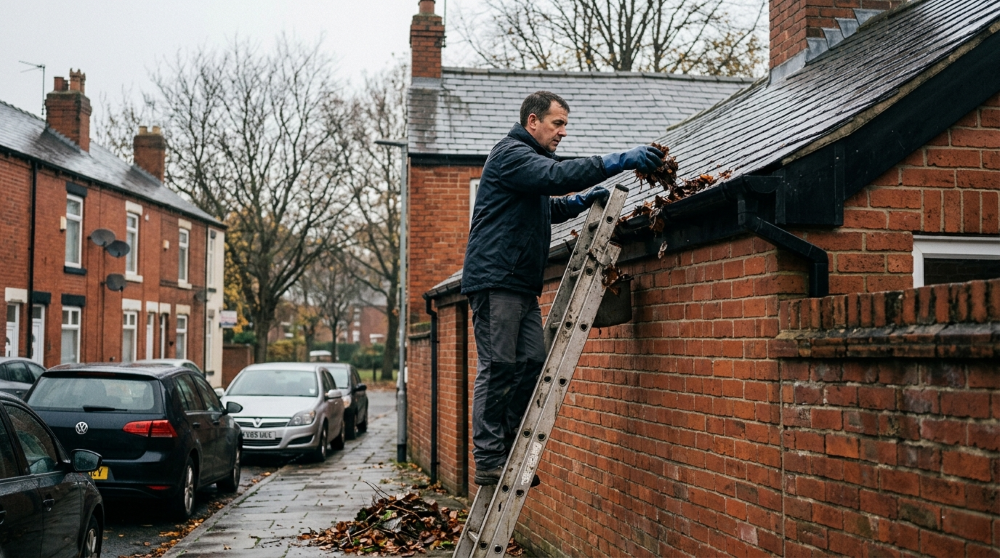
- Clear the gutters and downpipes. Do this once the leaves have come down. Blocked gutters overflow, and that water runs down the wall and finds its way in - one of the most common causes of damp in British homes. A single-storey run you can reach safely is a DIY job; anything higher is one for a handyman with the right ladder.
- Bleed the radiators. If the tops are cold while the bottoms are warm, there's air trapped inside and your heating is working harder than it needs to. A radiator key costs a couple of pounds and the job takes ten minutes.
- Lag exposed pipes and know where your stopcock is. Pipes in lofts, garages and outside taps are the ones that freeze and burst. Foam lagging is cheap insurance. And before you ever need it in a panic, find your internal stopcock and check it turns - it's what stops a burst pipe flooding the house.
- Sweep the chimney. If you burn wood or coal, HETAS recommends sweeping at least twice a year for wood and bituminous house coal, and at least once a year for smokeless fuels. A clogged flue is both a chimney-fire risk and a carbon monoxide risk. Use a sweep, ideally before the heating season starts.
- Check the roof from the ground. After the first big storm, stand back with binoculars and look for slipped or missing tiles and any sagging. You won't catch everything, but you'll catch the obvious problems before they let water in.
Don't go on the roof or up a tall ladder yourself. Falls from height are one of the most common causes of serious DIY injury. Roof work, high gutters and chimney inspections are exactly the sort of job worth paying a handyman or roofer to do from the right equipment.
Spring & Summer: The Outdoor Jobs
When the weather warms up, the work moves outside. The theme here is catching the slow, creeping damage - rot, rust, blocked drains and worn sealant - while it's still small and the conditions are good for fixing it.
- Give the gutters a second look. Clear the spring debris: blossom, seed pods and the moss that builds up over winter. This is the second of the two yearly clears most UK homes need.
- Reseal around baths, showers and basins. When the silicone goes black, cracked or peels away, water gets behind it and into the wall or floor below. Raking out the old sealant and running a fresh bead is a cheap job that prevents an expensive one.
- Touch up outdoor paint and treat timber. Bare wood on fences, sheds, fascias and window frames rots once the weather gets at it. A dry summer spell is the time to sand, treat and repaint before another winter.
- Clear the drains and gullies. Lift the grids over outside drains and clear the leaves and silt. A slow drain in summer becomes a flooded one in an autumn downpour.
- Check fences, gates and paths. Wobbly posts, dropped gates and lifted paving are easy fixes now and trip hazards later. A handyman can run through a list of these in a single visit.
- Descale in hard-water areas. Much of southern and eastern England has hard water, which furs up showerheads, taps and kettles. A regular descale keeps them flowing and makes appliances last longer.
Once a Year, No Excuses
Some jobs only need doing yearly, but they're the ones with the highest stakes if you let them slide. Put a recurring reminder in your phone for each.
The boiler service - what it's really for
Here's an honest take that cuts against the usual sales pitch. A yearly boiler service is often sold on the promise that it pays for itself in efficiency, and that's the weakest reason to do it - the fuel savings from a service are usually modest. The real reasons are better: it keeps the manufacturer's warranty valid (skip a service and a future breakdown claim can be refused), it catches wear before it becomes a winter breakdown, and it checks the appliance isn't leaking carbon monoxide. Those three things, not a few pounds off your gas bill, are why it stays at the top of the list.
The electrical check (EICR)
You don't need this every year, but it belongs in your yearly "is this due?" review. An Electrical Installation Condition Report is a thorough inspection of your wiring, sockets and consumer unit by a qualified electrician. Electrical Safety First recommends one at least every ten years for an owner-occupied home, or sooner if you've just moved in and don't know its history. For rented homes, an EICR every five years is a legal requirement, not a suggestion.
The yearly walk-round
Once a year, go round the whole house looking for the small stuff: dripping taps, loose handles, cracked grout, sticking doors, a fence panel on its way out. None of it is urgent on its own, which is exactly why it never gets done. Write it all on one list and book a handyman for a half-day - bundling jobs like this is far better value than calling someone out for each one, as our guide to handyman costs explains.
The Full Checklist at a Glance
Here's the whole year in one place. "Who" is a guide, not a rule - a confident DIYer will take on more, and there's no shame in paying someone for any of it.
| Task | How often | Who |
|---|---|---|
| Test smoke & carbon monoxide alarms | Monthly | You |
| Check under sinks & around appliances for leaks | Monthly | You |
| Press the RCD test button on the consumer unit | Every 3 months | You |
| Clear gutters & downpipes | Twice a year (autumn + spring) | You / handyman |
| Reseal baths, showers & basins | As needed (check yearly) | You / handyman |
| Bleed radiators | Yearly (autumn) | You |
| Lag exposed pipes; check the stopcock turns | Yearly (before winter) | You |
| Sweep the chimney | 1-2 times a year if in use | Registered sweep |
| Boiler service & gas safety check | Yearly (before winter) | Gas Safe engineer |
| Replace smoke/CO alarms past their date | ~ every 10 years | You |
| Electrical check (EICR) | ~ every 10 years (owner-occupied) | Registered electrician |
| Whole-house walk-round & small repairs | Yearly | You / handyman |
What You Must Leave to a Registered Professional
Most of this checklist is fair game for a homeowner or a general handyman. A few jobs are not - by law they must be done by someone on the right register, and doing them yourself (or paying a handyman to) can be illegal, dangerous, and invalidate your insurance. Our guide to what a handyman can legally do covers the line in full, but in short:
Gas work
Anything connected to the gas supply - boiler, gas fire, gas hob, gas safety checks - must be done by an engineer on the Gas Safe Register. No exceptions.
Gas Safe registered engineerFixed electrical work
New circuits and most work in kitchens and bathrooms fall under Part P building rules. The EICR and any rewiring need a qualified electrician.
Registered electricianStructural & asbestos
Removing a wall, anything load-bearing, or disturbing suspected asbestos in an older home needs the right specialist and, often, building control sign-off.
Structural engineer / licensed specialistA good handyman knows where this line sits and will tell you when a job is beyond what they can legally take on. That honesty is a sign you've found a good one - not an upsell to be wary of.
Frequently Asked Questions
How often should I service my boiler?
Once a year, ideally before winter. Most boiler manufacturers require an annual service by a Gas Safe registered engineer to keep the warranty valid, and the check also catches faults and carbon monoxide risks early. It's not a legal duty for an owner-occupier, but it's the single maintenance job most worth keeping on top of.
How often should I test my smoke alarms?
Test every smoke and carbon monoxide alarm at least once a month using the test button. Separately, replace the whole unit roughly every ten years, even if it still beeps when tested, because the sensor degrades over time. Check the date printed on the back so you know when each one is due.
Do I legally have to do any home maintenance if I own my home?
As an owner-occupier, almost none of it is a legal duty - the smoke alarm, gas safety and electrical rules that make headlines apply to landlords, not to people living in their own home. The reasons to keep up with maintenance are practical and financial: safety, keeping warranties valid, and stopping a small problem turning into an expensive one.
How often should gutters be cleaned in the UK?
For most UK homes, twice a year is the sensible minimum - once in late autumn after the leaves have come down, and once in spring. Homes surrounded by trees may need clearing more often, while a home with no trees nearby might manage on one clean a year. Blocked gutters are a leading cause of damp and overflowing water down the walls.
How often does a house need an electrical safety check (EICR)?
Electrical Safety First recommends an Electrical Installation Condition Report (EICR) at least every ten years for an owner-occupied home, or sooner if you notice problems or have just moved in. For rented homes it's a legal requirement at least every five years. Between checks, press the test button on your consumer unit's RCD about every three months.
Which home maintenance jobs can I do myself and which need a tradesperson?
Most of the checklist is DIY: testing alarms, bleeding radiators, clearing gutters on a single-storey extension, checking for leaks. A handyman is ideal for the jobs that need a ladder, tools or a spare half-day, such as gutters, sealant and minor repairs. Gas work and most fixed electrical work must be left to a Gas Safe or registered electrician by law.
This guide is general information for UK homeowners, not professional, legal or safety advice. Always follow manufacturer instructions and current regulations, and use a suitably registered tradesperson for gas, electrical and structural work. See our full disclaimer.
Got a List Building Up?
Gutters, sealant, a sticking door and three other jobs you've been meaning to sort? Bundle them into one visit. The UK Handyman Directory lists handymen across the country with direct contact details - search your area, view listings, and get in touch directly. Free, fast, no sign-up.
Find a Handyman Near You