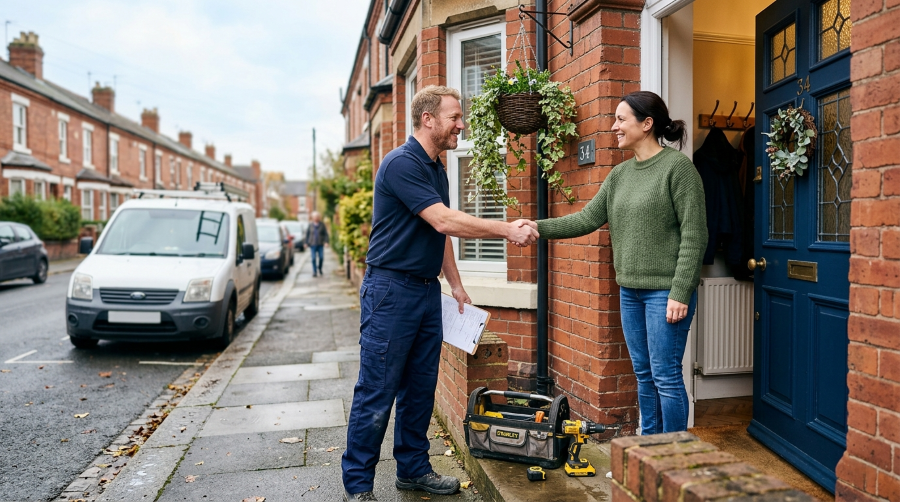
The shelf has been propped against the wall for three weeks. You've got a name off the local Facebook group, a card that came through the door, and four profiles open on a trade website - and no real idea which one won't let you down. Finding a handyman is easy. Finding a good one, first time, is the part nobody makes simple.
Here's the uncomfortable bit most hiring articles skip. Unlike a gas engineer or an electrician, a handyman needs no licence, no registration and no qualification to start work. Anyone can buy a van and a drill on Monday and call themselves a handyman on Tuesday. That isn't a reason to panic - the large majority are honest and good at what they do - but it does mean the checking falls to you. This guide is that checking, in the order you'd actually do it: where to look, how to sort the good from the chancers, and how to pay so you're covered if it goes wrong.
Start With Word of Mouth
The single best lead is a personal recommendation from someone who has seen the finished work with their own eyes. A neighbour whose kitchen shelves are still dead level a year on tells you more than any star rating. Ask around - the street, the family WhatsApp, the school gate, the local Facebook or Nextdoor group. People are quick to name someone who turned up when they said they would and charged what they quoted.
One caveat. "My mate's brilliant" is a starting point, not the finish. The job your neighbour loved might be nothing like yours - someone who hangs a perfect TV bracket isn't necessarily the right call for a sticking sash window. Treat a recommendation as a strong shortlist entry, then run the same checks you'd run on anyone else.
Where to Look Beyond a Recommendation
When you don't have a name to go on, you've got two broad routes: a directory that lists local handymen, and a review platform that screens its members. They do different jobs, and it helps to know which is which.
- Directories (including this site) list businesses by area so you can find who covers your postcode and contact them directly. They're built for discovery. Most, including the UK Handyman Directory, don't vet or guarantee the businesses listed - our how this site works page is upfront about that - so the checks below are yours to make.
- Review platforms such as Checkatrade, MyBuilder, TrustATrader and Rated People sit between you and the trader and apply some level of screening before a member can appear. What they check varies a lot from one to the next, and a membership badge is reassurance, not a cast-iron guarantee.
There's also TrustMark, the only government-endorsed quality scheme covering work in and around the home. A TrustMark-registered trader has signed up to a code of conduct and standards set by an accreditation body. For a big project it's a genuine mark of quality and a route to redress; for a half-hour job it's a nice-to-have rather than a deciding factor. Whichever route you use, the name you end up with still has to pass the same handful of tests.
The Insurance Question (and the Honest Answer)
"Are you insured?" is the question everyone knows to ask, and almost nobody understands the answer to. So let's be straight about it: a handyman is not legally required to hold public liability insurance. The only insurance the law forces on a business is employers' liability cover, and only if it actually employs staff. A solo handyman with no employees can legally carry no insurance at all.
That matters because "fully insured" on a website can mean a great deal or, occasionally, very little. Public liability insurance is the one that protects you: it covers the cost if the handyman damages your property or injures someone while working - a drill through a pipe, a ladder through a window. A professional who takes the work seriously will usually carry it as a matter of course.
So ask - and for anything where damage is a real possibility, ask to actually see the certificate, not just hear "yes". According to insurance specialists Markel Direct, a valid certificate shows the insured business name, the insurer, the policy dates and the indemnity limit (the maximum the policy pays out). Check the dates are current and the name matches who you're hiring. For a quick, low-risk job - hanging a picture, changing a tap washer - the absence of cover may not bother you. For a day's work near pipes, wiring or glass, it should.
Check Qualifications Where They Actually Count
A general handyman doesn't need a certificate to put up shelves, fill cracks, assemble flat-pack or reseal a bath, and asking for one would be odd. But some work is off-limits to anyone without specific registration, no matter how handy they are - and that's where a "yes, I can do that" should make you slow down.
- Gas work must be done by an engineer on the Gas Safe Register. You can check an engineer's registration on that site. No exceptions, ever.
- Notifiable electrical work (new circuits, consumer units, and most work in bathrooms or kitchens) has to be done or signed off by someone registered under Part P of the Building Regulations, often through a scheme like NICEIC. A handyman can swap a like-for-like socket or light fitting; he can't legally rewire your kitchen.
If a handyman offers to take on gas, major electrics, structural changes or anything involving asbestos, that's not a green light - it's the moment to step back and bring in the registered trade. Our guide to what a handyman can legally do in the UK sets out exactly where that line falls, and a good handyman will point to it themselves rather than wing it.
Read Reviews Like a Sceptic
Reviews are useful, but only if you read them properly. A wall of five-star one-liners with no detail is weak evidence; a handful of specific reviews that mention the actual job, the tidiness, the timekeeping and how a problem was handled is worth far more. Look for the awkward ones too - how a tradesperson responds to a three-star review tells you more about them than a dozen glowing ones.
- Check more than one source. Cross-reference Google, the trade platform and any local group. A pattern across sites is reliable; a single curated page is not.
- Read the recent ones. A business can coast for years on old praise. The last few months tell you who they are now.
- Ask to see recent local work. A genuine tradesperson can usually point to jobs nearby and, often, put you in touch with a past customer.
Get It in Writing, and Get More Than One
For anything beyond an hour or two, get two or three written quotes. It's the only reliable way to learn the going rate for your job in your area, and it quietly weeds out anyone whose number is wildly out of line. Remember that the cheapest quote isn't automatically the best - a low price that has to be redone by someone else stops being cheap very quickly.
A written quote does two things: it lets you compare like with like, and it's your evidence if there's a dispute later. A good one spells out the price and how it's charged (hourly, half-day, day or fixed), whether materials are included, whether VAT applies, and what the job actually covers. If you're not sure what's normal to pay, our guide to how much a handyman costs in the UK walks through hourly rates, day rates and the call-out fee that catches people out.
A quick tip that saves real money: handymen charge a minimum fee or call-out, so booking one job at a time is the expensive way to do it. Save up the squeaky door, the loose handle, the blown bulb and the wobbly shelf, and put the whole list in one quote. You pay the call-out once instead of five times.
The Red Flags That Should Send You Elsewhere
Most handymen are straight. The few who aren't tend to give themselves away early, and consumer group Which? and Trading Standards flag the same patterns again and again. Treat any of these as a reason to pause:
- They came to you uninvited. Doorstep cold-callers offering to fix something they've "noticed" are best turned away. Reputable traders don't tout for work door to door.
- You're being rushed. "This price is only good today" or "it needs doing right now" is pressure, not urgency. A real quote doesn't expire by teatime.
- A big payment is wanted upfront. Asking for materials money on a larger job is one thing; wanting a large share of the total before lifting a tool is another.
- It's cash only, no paperwork. A discount "for cash" with no receipt and no written quote leaves you with nothing to fall back on.
- There's no fixed address or landline - just a mobile. You want to know who you're dealing with and where to find them if something goes wrong.
- The quote is far below everyone else's. One price that undercuts all the others by a mile is a warning, not a win.
Paying So Your Money Is Protected
How you pay changes how protected you are. For most small jobs you simply pay when the work's done and you're happy with it - no deposit needed. On a bigger job, a deposit to cover materials the handyman has to buy in advance can be fair, but you should never pay the full amount before the work is finished, and you should keep a record of anything you hand over.
Where the sums are larger, paying by credit card gives you a layer of protection that cash never will. Under Section 75 of the Consumer Credit Act, if a single job costs more than £100 and up to £30,000, your card provider is jointly liable with the trader - so if the work is never done or the business folds, you can claim from the card company. Crucially, that protection applies even if you only put the deposit on the card. Debit cards aren't covered by Section 75, though the voluntary chargeback scheme may still help you recover money in some cases.
None of this makes cash wrong. Paying cash is perfectly legal and plenty of good handymen prefer it. The thing to watch isn't cash itself - it's cash plus no receipt, no quote and a nudge to keep it quiet. A clear paper trail protects you and is a fair sign of a business that does things properly.
Your Rights If It Goes Wrong
You're better protected than you might think, and it doesn't depend on the handyman signing anything. The Consumer Rights Act 2015 says any service must be carried out with reasonable care and skill, in a reasonable time, and for a reasonable price where none was agreed up front. A trader cannot contract out of those rights, so a line in their terms trying to dodge them isn't binding.
If a job falls short, the first move is simple: put it in writing, explain what's wrong, and give them a fair chance to put it right - that's usually all it takes. If it isn't, the free Citizens Advice consumer service can talk you through your options, including alternative dispute resolution (a mediator rather than a court) and, as a last resort, the small claims court for disputes up to £10,000 in England and Wales. Keeping your quote, messages and payment records makes any of these far easier.
Frequently Asked Questions
How do I find a good handyman in the UK?
Start with a personal recommendation from someone who has seen the finished work, then widen the search to a local directory or a review platform. Whoever you find, do the same checks: read reviews across more than one site, ask about public liability insurance, get the price and what it covers in writing, and get two or three quotes for anything more than an hour or two of work.
Does a handyman need to be insured in the UK?
No. A handyman is not legally required to hold public liability insurance, so "are you insured?" is a fair question that can honestly be answered no. The only cover the law forces is employers' liability insurance, and only if the business employs staff. A good handyman usually carries public liability cover anyway, and for any job where damage is possible you should ask to see the certificate.
Should I pay a handyman a deposit?
For most small jobs there is no need to pay anything before the work is done. On a larger job a deposit to cover materials the handyman has to buy upfront can be reasonable, but be wary of any request for a large slice of the total before work starts. Never hand over the full amount in advance, and keep a written record of anything you do pay.
Is it safer to pay a handyman by card or cash?
Paying by card can give you extra protection. Under Section 75 of the Consumer Credit Act, credit card payments for a single job costing more than £100 and up to £30,000 make the card provider jointly liable if the work is not done or the trader goes under. Cash is perfectly legal, but an offer of a discount for cash with no receipt and no paperwork is a warning sign worth heeding.
What are the warning signs of a rogue trader?
Classic red flags include cold-calling at your door, pressure to decide today, a demand for a large payment upfront, cash-only with no receipt or written quote, and no fixed business address or landline - just a mobile number. A quote that is far below all the others is a warning, not a bargain. Take your time, get it in writing, and walk away from anyone who rushes you.
What can I do if a handyman does a bad job?
Under the Consumer Rights Act 2015 a service must be carried out with reasonable care and skill, and the trader cannot contract out of that. If the work falls short, put your complaint in writing and give them the chance to put it right. If that fails, the Citizens Advice consumer service can advise on your options, including alternative dispute resolution and, as a last resort, the small claims court.
This guide is general information for UK households, not legal or financial advice. The UK Handyman Directory lists businesses but does not vet, endorse or guarantee them - always make your own checks before hiring. See our disclaimer for more.
Find a Handyman in Your Area
Now you know what to check, find someone local to put on your shortlist. The UK Handyman Directory lists handymen across the country with direct contact details. Search by your area, view listings, and get in touch directly - free, fast, and no sign-up required.
Find a Handyman Near You