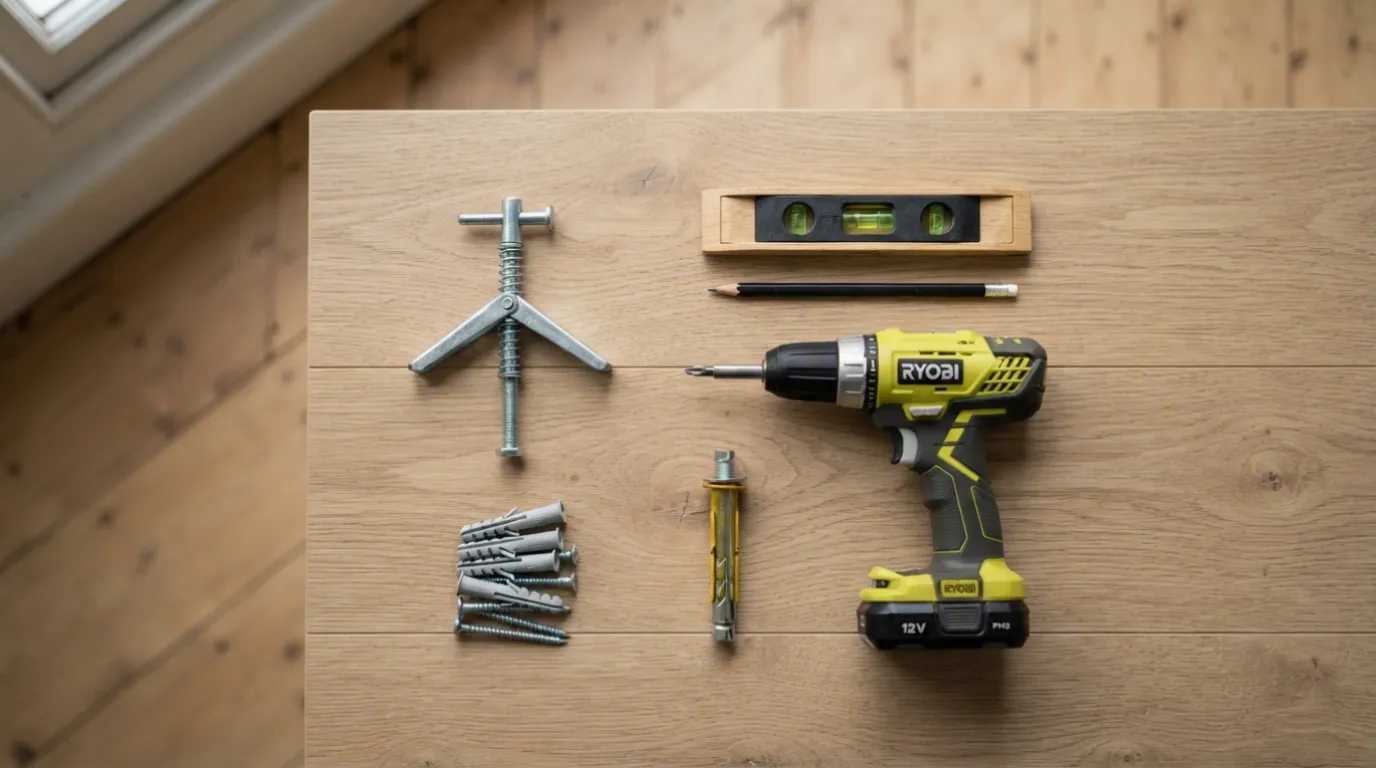
You drill a hole, push in the little plastic plug that came in the pack, drive the screw, hang the mirror - and a week later it's on the floor with a fist-sized crater of crumbled plasterboard around the hole. It's one of the most common jobs a handyman gets called out to redo, and it's almost always the same mistake. The plug was made to grip solid brick. The wall was hollow plasterboard. There was nothing for it to bite into.
Getting this right is not about being good with tools. It's about two decisions made before you pick up the drill: what is the wall actually made of, and how heavy is the thing you're hanging. Match the fixing to both and you're done. Guess at either and you're patching a hole. This guide walks through both, then goes object by object - pictures, mirrors, shelves, TVs - so you know exactly which fixing to reach for.
First, Work Out What Your Wall Is Made Of
Walls inside a UK home fall into three broad types, and the fixing you need is completely different for each. Before anything else, find out which one you're dealing with. The quickest test is your knuckles: tap the wall and listen.
- Solid masonry (brick or block). A dull, solid thud, and it hurts your knuckles a little. These are usually your external walls and older internal walls, especially downstairs. A plastic wall plug and screw works here because the plug has solid material to expand against.
- Plasterboard on a timber frame (a stud wall). A hollow, drum-like sound, often on internal walls and upstairs. Behind a sheet of plasterboard about 12.5mm thick, as Neasden Hardware notes is standard in the UK, is a gap and then vertical timber studs. This is the wall people get wrong.
- Lath and plaster. Found in Victorian and Edwardian houses. Also sounds hollow, but when you drill it, it's flaky and throws out far more dust than clean plasterboard, because it's plaster pushed through thin wooden strips. It's fragile and unpredictable, so treat it with care.
If in doubt, drill a small test hole somewhere it won't show, like behind where the frame will sit. Clean grey or white dust and firm resistance points to plasterboard; heavy grit means masonry; flaky brown-tinged dust and crumbling means lath and plaster. This one check decides everything that follows.
Find the Studs - They're the Strongest Fixing There Is
On a plasterboard wall, the single best thing you can screw into isn't a clever anchor at all. It's the timber stud behind the board. A screw driven into solid wood will hold far more than any fixing gripping the board alone, so for anything with real weight, your first move is to hunt for a stud.
The vertical studs usually sit somewhere between 400mm and 600mm apart. Tap horizontally across the wall and you'll hear the sound change from hollow to a duller, more solid note where a stud runs behind. That gives you a rough location, but for accuracy use an electronic stud detector. They cost well under twenty pounds, and the better ones also flag live cables and metal pipes, which matters enormously (more on that below).
Once you've found a stud, mark it top and bottom with a pencil so you know it runs straight, and try to line up at least one of your fixing points with it. If the thing you're hanging is wider than a single stud spacing, you may be able to catch two studs, which is ideal for shelves and TV brackets. Where a stud simply isn't in a useful spot, that's when the plasterboard fixings below earn their keep.
Plasterboard Fixings: Which One for Which Weight
This is the part that trips everyone up, so it's worth understanding rather than guessing. The reason the wrong fixing fails is simple: plasterboard is thin and brittle, so a good plasterboard fixing works by gripping the back of the board and spreading the load over a wide area, instead of relying on the crumbly face. The heavier the item, the more spread you need.
Here's the honest hierarchy, with the sort of weights each type handles. Treat every figure as a guide, not a promise - board condition, whether it's a single or double layer, and how you spread the load all change what's safe.
| Fixing type | Rough load per fixing | Best for |
|---|---|---|
| Basic plastic plug (in board) | A few kg at most | Honestly, not much - avoid for anything you'd mind losing |
| Self-drive / self-tapping plasterboard plug | Up to ~10kg | Light frames, small mirrors, hooks; screws in with a screwdriver |
| Hollow-wall anchor (metal molly bolt) | ~10-25kg | Curtain poles, medium mirrors, coat rails; reusable |
| Spring toggle | ~25kg and up | Heavier single loads; wings spring open behind the board |
| Heavy-duty anchor (e.g. Gripit) | High (see note) | Radiators, heavy units, TV brackets - big drill hole needed |
A couple of these deserve a word. Hollow-wall anchors, the metal ones often called molly bolts, expand into an umbrella shape behind the board as you tighten the screw, clamping it tight; they're rated to around 10-25kg and can be reused. Spring toggles have sprung metal wings that fold flat, push through a drilled hole and snap open on the far side, spreading the load widely - which is why Neasden Hardware rates them for 25kg and up, noting they've held over 40kg in tests while still recommending a conservative working limit around 15kg per fixing for the long haul.
About those huge weight numbers. Heavy-duty anchors quote eye-catching figures - Gripit, for example, publishes maximums from 71kg for its yellow anchor up to 113kg for the blue. Those are laboratory maximums in ideal, single-fixing conditions, not a guarantee for your particular wall. The board is often the weak point, not the anchor. For genuinely heavy items, spread the weight across several fixings, screw into a stud where you can, and stay well under the headline number.
Fixing into Brick and Masonry
Solid walls are more forgiving, which is why the little plugs in the pack usually work - on brick. Here the job is matching the plug and drill bit to the screw, and drilling a clean hole. Use a masonry drill bit and, on hard brick or concrete, a hammer drill or the hammer setting. Drill to the depth of the plug, blow or brush the dust out of the hole, tap the plug in flush, then drive the screw so it bites.
The mistake to avoid is the mirror image of the plasterboard one: don't assume every wall is brick. People reach for the familiar red or brown wall plugs and shove them into plasterboard, where they have nothing to grip and pull straight back out. Brick plugs belong in brick. Plasterboard needs the anchors above. When you're drilling into old, soft or crumbly brick, or into the mortar line rather than the brick face, go up a plug size and consider a longer screw so it reaches firmer material.
Hanging It by What It Is
The right fixing depends as much on the object as the wall. Here's the quick version for the things people hang most.
How to hang a picture
For a light framed print of a kilo or two, you often don't need to drill at all. Adhesive picture strips or a single hardened picture hook tapped into the plaster will hold it, and both come off cleanly later. For heavier frames, mark your height, run a detector over the spot to check for cables, drill a small hole, push in a plasterboard plug and drive the screw. Hang the middle of the picture at roughly eye level, and use a spirit level (the one built into your phone works fine) so it sits straight. For a row or a gallery wall, cut a paper template for each frame and tape them up first to settle the layout before a single hole goes in.
How to hang a mirror, including a heavy mirror
Mirrors are where people come unstuck, because glass is heavier than it looks and a falling mirror is dangerous. A small mirror follows the picture rules. For a heavy mirror, weight and spread are everything. Try hard to get at least one fixing into a stud. Where you can't, use two good hollow-wall anchors or spring toggles set well apart, so the load sits on two points rather than one, and hang from the mirror's D-rings or a two-part cleat rather than a single central screw. If it's a large statement mirror on bare plasterboard with no stud in reach, this is a sensible one to hand to a professional - the cost of fitting it is a lot less than the cost of replacing it and repairing the wall.
How to put up a shelf
A shelf is a lever: the further out you load it, the harder it tries to tear the brackets off the wall, so shelves punish weak fixings more than almost anything. Wherever possible, screw the brackets into studs. If the shelf spans two studs, even better. When you have to fix into plasterboard alone, use proper anchors rated well above the weight you plan to load on, keep heavy items close to the wall rather than at the front edge, and don't overload it. Get both brackets level with each other, or everything you put on the shelf slides to one end.
Mounting a TV
A wall-mounted TV combines real weight with a bracket that pulls hard at the top, so it's the one most worth getting right. On masonry it's straightforward with the correct plugs and long screws. On plasterboard, aim to bolt the bracket through into the studs; if the stud spacing doesn't match the bracket holes, heavy-duty anchors are the fallback, sized to the TV. Because a TV mixes weight, cost and often hidden cabling, plenty of people pay to have it done. Our guide to how much a handyman costs in the UK covers typical prices, and you can compare that against the fixed-price TV-mounting services many handymen offer.
Before You Drill: Cables and Pipes
Drilling blind into a wall can put a bit straight through a live cable or a water pipe, and both are a genuinely bad day. UK wiring rules (BS 7671) mean cables tend to run in predictable safe zones: straight up and down and straight across from sockets and switches, in a strip along the top of the wall, and down the internal corners where two walls meet. As DIY Doctor explains, these zones are exactly where you should expect hidden cables to be.
The catch is that "expect" isn't "guarantee" - not every wall was wired to the letter. So the rule is simple: keep clear of the obvious zones above and to the sides of sockets and switches, and run a cable and pipe detector over the spot before you drill anywhere near one. A combined stud, cable and pipe detector does all three jobs and is cheap insurance. If the detector beeps and you're not sure, stop, and don't drill there.
When to Do It Yourself, and When to Call Someone
Most wall jobs are well within a confident DIYer's reach: pictures, small mirrors, a single shelf, a curtain pole. Buy the right anchors, use a detector, take your time, and you'll save the call-out fee easily. These are exactly the kind of small, satisfying jobs that a bit of care and the correct fixing sort out in an afternoon.
It's worth paying a professional when the stakes rise: a large heavy mirror or a TV on plasterboard where the studs won't cooperate, anything over a socket or where you suspect awkward wiring, fragile lath-and-plaster walls, or simply a long list of things to put up that would otherwise eat your weekend. As a rough steer, price guides put hanging a picture or a curtain rail at around £45, and mounting a TV between £50 and £150 depending on size and cable-hiding, per MyBuilder and MyJobQuote. Most handymen charge around £30 an hour, rising to about £50 in London, according to Checkatrade, and nearly all apply a minimum charge - so the smart move is to save several jobs up and get them all done in one visit. If that's the way you're leaning, you can find a handyman near you in a couple of clicks.
Frequently Asked Questions
What fixings should I use for a plasterboard wall?
It depends on the weight. For light things up to a few kilos, a self-drive plasterboard plug is fine. For medium loads up to around 25kg a hollow-wall anchor (a metal molly bolt) or a spring toggle is the safer choice, because both grip the back of the board and spread the load. For anything heavy, screw into the timber stud behind the board rather than the board itself, or use a heavy-duty anchor and be conservative about the weight. Never use the red or brown plastic plugs meant for brick in plasterboard - they have nothing solid to expand against and will pull straight out.
How much weight can a plasterboard wall hold?
Less than most people think, and the honest answer is that it depends on the fixing and how you spread the load. A basic plug pushed into the board holds only a few kilos. Good hollow-wall anchors and spring toggles are rated to roughly 25kg or more each, and heavy-duty anchors quote much higher lab figures, but those are ideal-condition maximums. For a heavy mirror or a TV, the reliable answer is to find the studs and screw into the timber, which is far stronger than the board itself.
How do I find a stud in my wall?
On a plasterboard wall the vertical timber studs usually sit about 400 to 600mm apart. Tap along the wall and listen for the duller, more solid sound where a stud is, versus the hollow sound of the gap. The reliable method is an electronic stud detector, which also warns you about hidden cables and pipes. Most detectors cost under twenty pounds and pay for themselves the first time they stop you drilling into a live cable.
Can I hang a heavy mirror on a plasterboard wall?
Yes, but do it properly. For a heavy mirror the best fixing is a screw into a stud, so try to line at least one bracket up with the timber. Where you can't, use two good hollow-wall anchors or spring toggles spread apart rather than one fixing carrying everything, and use the mirror's D-rings or a two-part cleat so the load sits on two points. If the mirror is large and heavy and the wall is plasterboard with no stud in a useful spot, it is worth paying a handyman to fit it safely.
How do I hang a picture without making a mess of the wall?
For a light picture you often don't need to drill at all. Adhesive strips or a single picture hook pinned into the plaster will hold a framed print of a kilo or two. For heavier frames, mark the height, check for cables with a detector, drill a small hole, push in a plasterboard plug and drive the screw. Use a spirit level or the level on your phone so it hangs straight, and hang the centre of the picture at roughly eye level.
How much does it cost to have a handyman put things up on the wall?
As a rough guide, hanging a picture or putting up a curtain rail costs around £45, and mounting a TV on the wall typically runs between £50 and £150 depending on the size and whether cables are being hidden, with an average near £100. Most handymen charge around £30 an hour, rising to about £50 in London, and apply a minimum charge, so it is far better value to save up several jobs and book them into one visit.
This guide is general information, not a substitute for professional advice. Fixing weight ratings vary by product and wall condition - always check the manufacturer's stated safe working load, and if a job involves electrics, gas or anything you're unsure is safe, use a qualified tradesperson.
Rather Not Drill It Yourself?
From a single heavy mirror to a whole list of shelves, pictures and a TV to mount, a local handyman can put it all up safely in one visit. The UK Handyman Directory lists handymen across the country with direct contact details - search your area, view listings, and get in touch directly. Free, fast, no sign-up.
Find a Handyman Near You