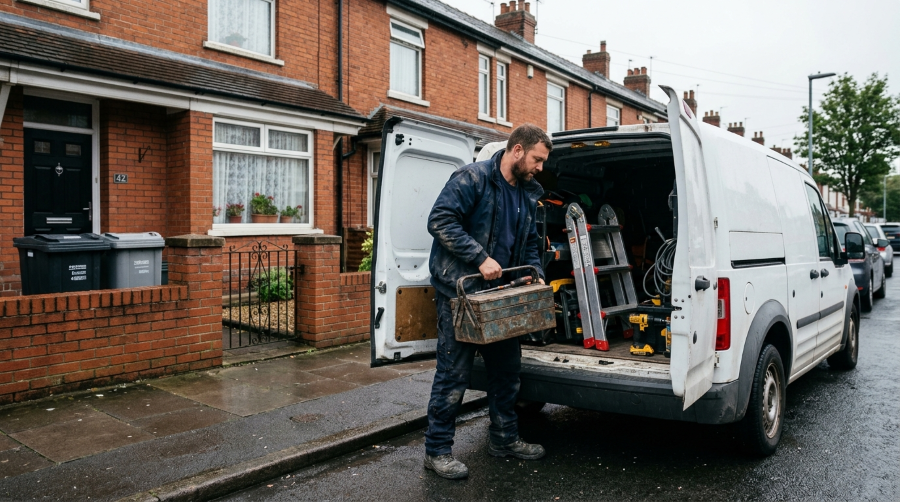
Here's the thing most "how to become a handyman" articles get backwards. They open with a list of courses you should take, as if a certificate is the thing standing between you and a living. It isn't. In the UK there's no handyman licence and no exam to pass. If you can hang a door, build a flat-pack wardrobe, fill a wall and put a shelf up straight, you can start trading as soon as you've sorted your tax registration.
So the qualification isn't the barrier. The barrier is everything around it - staying on the right side of the law, getting insured, doing your own books, and keeping a steady stream of customers coming through the door. Get those right and being a multi-skilled handyman is one of the easier trades to set up on your own, with low start-up costs and demand that never really dries up. This guide walks through the lot, in the order you'd actually do it.
How to Start a Handyman Business: The Steps
Before the detail, here is the whole path in one place. Starting a handyman business in the UK is less about qualifications and more about working through these steps in order:
- Check the legal limits - know the gas, notifiable electrical and structural jobs you cannot take on.
- Register as self-employed with HMRC, usually as a sole trader.
- Sort your tax, National Insurance and VAT position and start keeping records from day one.
- Get insured - public liability as standard, employers' liability the moment you take on help.
- Register as a waste carrier if you will be removing customers' rubbish.
- Build your kit - a core tool set, a van and simple invoicing, kept lean to start.
- Get found - reviews, word of mouth and a directory listing where homeowners search.
The rest of this guide takes each step in turn.
Do You Need a Licence or Qualification?
No. There is no legal requirement to hold any qualification to work as a general handyman in the UK, and no register you have to join before you can take money for a job. General maintenance, small repairs, flat-pack assembly, painting and decorating, basic carpentry, putting up shelves, fitting blinds, sealing baths - all of it is unregulated. You can be doing it for paying customers next week.
That's a genuine advantage over most trades, and you should treat it as one. But "no qualification needed" is not the same as "anything goes". A few jobs are restricted by law no matter how confident you are, and those are covered next. The honest framing for your whole business is this: you can do most things, you must not do a small number of things, and being clear about which is which is what separates a professional from a liability.
The Jobs You Legally Can't Take On
This is the part to get straight before you take your first booking, because the penalties are real. Two areas are firmly off-limits unless you hold the specific registration:
- Gas work. Anything involving gas appliances or pipework must be done by an engineer on the Gas Safe Register. Touching gas without it is a criminal offence, not a grey area. This applies right across the UK.
- Notifiable electrical work. In England and Wales, certain electrical jobs - new circuits, consumer unit (fuse board) changes, and work in higher-risk spots - fall under Part P of the Building Regulations. To self-certify that work you need to be registered with a competent person scheme such as NICEIC or NAPIT; otherwise it has to be signed off by building control. Scotland and Northern Ireland have their own equivalent rules.
Structural alterations and anything that disturbs asbestos (a real risk in homes built or refurbished before 2000) are also jobs to refer on rather than attempt. None of this stops you doing the bread-and-butter work. It just means you build a couple of trusted local contacts - a Gas Safe engineer, a registered electrician - and hand those jobs across. Customers respect a tradesperson who says "that one's not mine to do" far more than one who has a go and gets it wrong. Our guide to what a handyman can legally do in the UK sets out exactly where the line sits.
Registering as Self-Employed
Almost everyone starts as a sole trader. It's the simplest setup: you and the business are the same legal thing, the paperwork is light, and you keep what you make after tax. You register with HMRC for Self Assessment online, set up a Government Gateway account, and HMRC sends you a Unique Taxpayer Reference (UTR), the 10-digit number you'll use to file each year.
You don't have to register the second you start. There's a £1,000 trading allowance - earn less than that from self-employment in a tax year and you needn't register at all. Once you go over it you must register, and by law no later than 5 October in your second tax year of trading. In practice, register as soon as you're serious about it rather than leaving it to the deadline. It's free and takes about ten minutes.
You can trade under your own name or pick a business name for your van and invoices - HMRC doesn't treat a trading name as a separate entity for a sole trader. A separate business bank account isn't legally required but makes your bookkeeping far less painful.
Tax, National Insurance and VAT
As a sole trader you pay Income Tax on your profit (income minus allowable expenses), not on everything you turn over. Fuel, tools, insurance, materials, phone and a share of running costs all come off before tax. Keep every receipt from day one.
On top of that comes National Insurance. Class 2 contributions no longer have to be paid by most self-employed people from 6 April 2024 - if your profits are above the small profits threshold you're treated as having paid them, which still protects your State Pension record. You'll usually pay Class 4 National Insurance through your tax return: currently 6% on profits between £12,570 and £50,270, and 2% above that.
You only have to register for VAT once your turnover passes £90,000 in a 12-month period (the threshold since April 2024). Most one-person handyman businesses stay well under that and never charge VAT, which can make you noticeably cheaper than a larger VAT-registered firm for the same job. Set aside a slice of every payment for your tax bill as you go - the single most common mistake new sole traders make is spending the lot and getting caught short in January.
The Insurance You Actually Need
No insurance is legally required to work as a sole-trader handyman on your own - but trading without public liability cover is a gamble that can end your business with one accident, which is why almost every working handyman carries it. The one cover the law does force on you is employers' liability, at least £5 million, the moment you take anyone on to help - including casual or part-time help. Tool insurance isn't compulsory, but a single van break-in can stop you earning overnight, so it's usually worth bundling in.
That's the short version for getting set up. For what each policy actually covers, real 2026 prices and how to choose a cover level, read our full guide to handyman insurance in the UK.
Worth saying clearly to customers: being insured is one of the easiest ways to stand out. Plenty of homeowners have been burned by an uninsured "man with a van", so "fully insured" on your listing and your invoice does real work for you.
The Waste Carrier Licence Most People Miss
This one trips up a huge number of new handymen, so it gets its own section. The moment you take away a customer's waste - the old kitchen unit you've replaced, a broken toilet, packaging, garden cuttings, a skip's worth of rubble - you are carrying someone else's waste, and that legally requires you to register as a waste carrier with the Environment Agency (or the equivalent body in Scotland, Wales and Northern Ireland).
There are two tiers. Carrying waste produced by someone else is upper tier registration, currently £184, valid for three years before you renew. If you only ever carry waste you've produced yourself, that's lower tier and free - but note that construction and demolition waste you generate still needs upper tier. For most handymen who clear away what they remove, upper tier is the one you need.
Two reasons to take it seriously beyond the law. First, fly-tipping someone else's waste, even by accident through a dodgy "clearance" contact, can land back on you. Second, registered carriers must pass waste to a licensed disposal site and keep the paperwork - which is exactly the standard a careful customer wants to see. It's a small cost that quietly marks you out as legitimate.
Handyman Training and Courses Worth Having
You don't need a qualification, but the right handyman training and courses make you more capable and easier to trust - and they let you take on better-paid work. None of these are mandatory; treat them as investments rather than entry tickets.
- Multi-trade courses. Short, practical courses in tiling, plastering, basic plumbing, carpentry and decorating fill the gaps in whatever you already know. Providers run these as intensive blocks aimed squarely at people setting up as handymen.
- City & Guilds and NVQs. The City & Guilds Property Maintenance route and the Level 2 NVQ Diploma in Building Maintenance (Multi-trade) are recognised qualifications with no formal entry requirements - useful if you want a credential to point to.
- Asbestos awareness. A half-day awareness course is cheap and sensible given how much pre-2000 housing stock you'll work in. It teaches you to spot it and stop, not to remove it.
- Going further. If you want to do your own notifiable electrics legally, that's a bigger commitment - the 18th Edition and inspection-and-testing qualifications plus competent-person scheme registration. Most handymen decide it isn't worth it and sub the work out instead.
The most valuable "training" of all is the unglamorous kind: turning up when you said you would, quoting clearly, and finishing the job tidily. That reputation earns more repeat work than any certificate.
Tools, Van and Start-Up Costs
One of the reasons this trade is so accessible is the low cost of entry. Checkatrade and others put a realistic start-up budget at roughly £1,500 to £5,000, and at the lower end if you already own a decent tool kit and a vehicle.
The main outlay breaks down as:
- Tools. A solid core kit - cordless drill and driver, hand tools, levels, a multi-tool, ladders, a decent toolbox - covers most jobs. Buy good versions of the things you use daily and basic versions of the rest; build up specialist kit as the work demands it.
- A vehicle. A small van that fits your tools and a few sheets of board is the workhorse. Buy second-hand to start, lease if cash flow is tight, and don't over-buy before you have the customers.
- The admin bits. Insurance, waste carrier registration, business cards, a simple invoicing app and a basic website or directory listing. None of it is expensive on its own and together it's what makes you look like a business rather than a bloke with a hammer.
Keep the early spending lean. It's far better to start small with what pays for itself and reinvest as the work grows than to sink thousands into a fully kitted van before you've proven you can fill a diary.
Getting Your First Customers
This is the part that actually decides whether you make a living, and it's where most new handymen underinvest. The work won't find you; you have to be findable. A few routes, roughly in order of how quickly they pay off:
- Tell everyone you know. Friends, family, neighbours, your old workmates. Word of mouth is the single biggest source of handyman work, and your first jobs almost always come from people who already trust you.
- Get listed where people search. Homeowners look for a local handyman online before they ask around. Being on directories - including our own UK Handyman Directory - puts your name in front of people at the exact moment they're looking to hire.
- Collect reviews from day one. Ask every happy customer for a short review. A handful of genuine recommendations does more for your bookings than any advert.
- Consider a quality scheme. TrustMark is the Government-endorsed standards scheme; registration is a credibility signal some customers look for, though it isn't essential when you're starting out.
Do good work, be easy to reach, and make sure you turn up in search results, and the repeat-and-referral flywheel starts turning. For a clear-eyed view of what the people hiring you actually look for - so you can be that handyman - it's worth reading our guide on how to find a good handyman from the customer's side of the table.
Frequently Asked Questions
Do you need a licence or qualification to become a handyman in the UK?
No. There is no handyman licence in the UK and no qualification you must hold to trade. You can legally start tomorrow doing general maintenance, repairs, flat-pack assembly, decorating and basic carpentry. The catch is that certain jobs are restricted by law: gas work must be done by a Gas Safe registered engineer, and notifiable electrical work must meet Part P of the Building Regulations. Doing those without the right registration is against the law, not just against good practice.
How do I start a handyman business in the UK?
Starting a handyman service comes down to a handful of steps rather than any licence. Register as self-employed with HMRC (most start as a sole trader), take out public liability insurance and add employer's liability the moment you take on any help, and register as a waste carrier if you'll be removing customers' rubbish. Sort the practical side - a reliable van, a core tool kit and simple bookkeeping - then get listed where homeowners search so the work can find you. There's no qualification you must hold to trade, but you must stay on the right side of the law on gas, notifiable electrical and structural work. Each of these is covered in full in the sections above.
How do I register as a self-employed handyman?
Most handymen start as a sole trader. You register with HMRC for Self Assessment once your self-employed income passes the £1,000 trading allowance in a tax year, and by law no later than 5 October in your business's second tax year. Registration is free and done online through GOV.UK; HMRC then sends you a Unique Taxpayer Reference. From there you keep records of income and expenses and file a tax return each year.
What insurance does a handyman need?
Public liability insurance is not a legal requirement for a sole-trader handyman, but going without it is a serious risk - it covers you if you damage a customer's property or someone is injured because of your work. Cover of £2 million costs roughly £75 a year on average, with quotes commonly between about £68 and £179. Employer's liability insurance, with at least £5 million of cover, is legally required the moment you take on any employee, even casual help.
Do I need a waste carrier licence as a handyman?
If you take away a customer's waste - old units, a broken toilet, packaging, garden cuttings - you need to register as a waste carrier with the Environment Agency. Carrying someone else's waste is upper tier registration, currently £184 and renewable every three years. Registering to carry only waste you produce yourself is lower tier and free, though construction and demolition waste you generate still needs upper tier. Many new handymen miss this and risk a fine.
How much can a self-employed handyman earn in the UK?
Self-employed handymen commonly charge around £25 to £40 an hour, rising to £50 or more in London, with full-day rates often between about £150 and £300. What you actually take home is lower once tax, National Insurance, insurance, fuel, tools and unpaid travel time come out. Employed handymen typically earn somewhere around £24,000 to £30,000 a year. Your real income depends far more on a steady flow of customers than on your headline rate.
What work can a handyman not legally do?
The main restrictions are gas work, which must be carried out by a Gas Safe registered engineer, and notifiable electrical work, which must comply with Part P of the Building Regulations in England and Wales. Working with asbestos and most structural alterations are also off-limits without the right qualifications and notifications. General repairs, fixing, fitting and decorating are all fine. If a job is regulated, the honest move is to refer it on rather than attempt it.
This guide is general information on setting up as a handyman in the UK, not legal, tax or financial advice. Rules, thresholds and fees change - always check the current position on GOV.UK and with the relevant body before you rely on a figure.
Ready to Get Found by Local Customers?
Once you're set up and insured, the next job is getting seen. List your handyman business on the UK Handyman Directory and put your name in front of homeowners searching in your area - it's how customers find a local handyman they can trust.
List Your Business