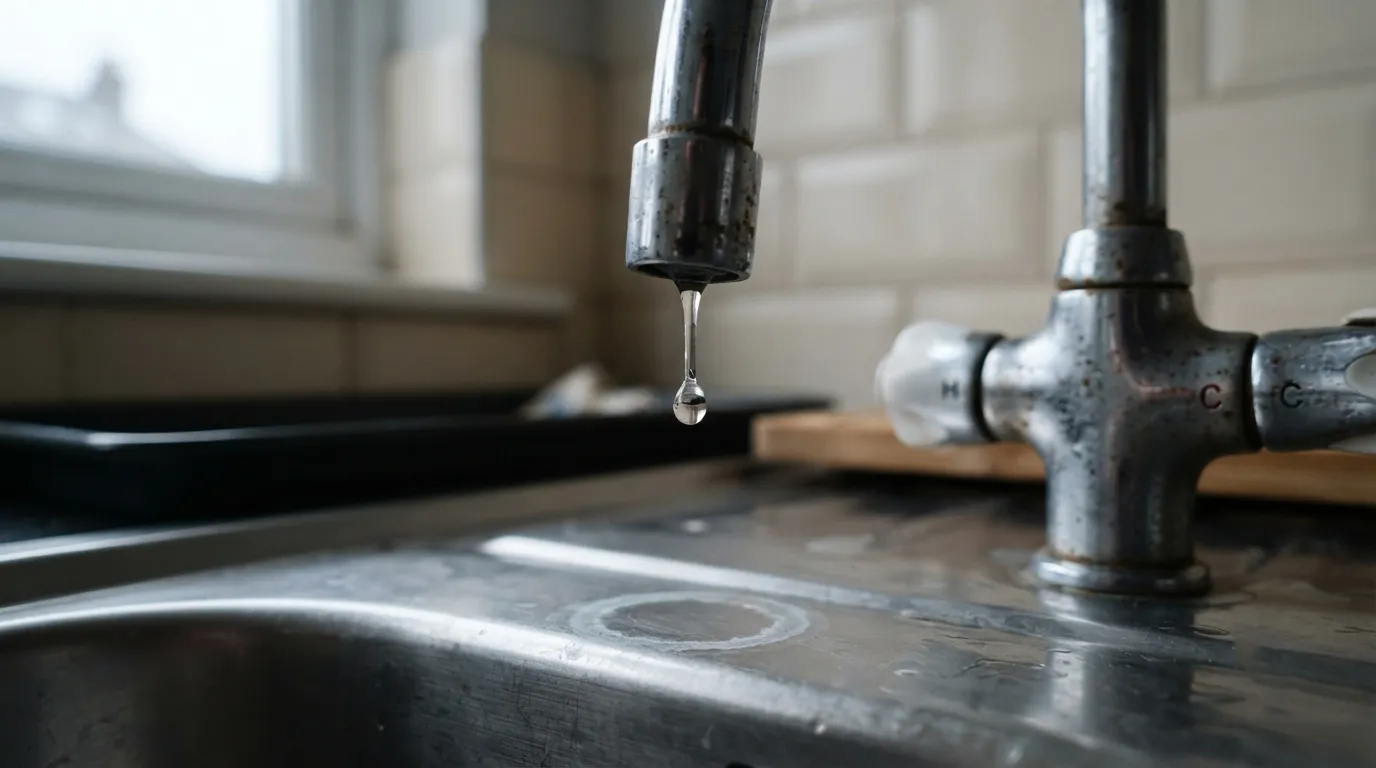
The drip you can hear from the next room is almost never the tap failing. It's one small component inside it: a perished rubber washer about the size of a five-pence piece, or a ceramic cartridge clogged with limescale. The part costs somewhere between a couple of pounds and about fifty.
The catch is that most of the advice out there still assumes you have a washer. Plenty of British kitchen taps fitted in the last thirty years don't have one. Follow the wrong instructions and you'll strip the tap down, find nothing that matches the diagram, and put it all back together still dripping. So the first job isn't the repair. It's working out which family of tap is sitting on your sink.
What a Dripping Tap Really Costs You
The headline figure gets quoted everywhere. WaterSafe, the national body for approved plumbers, reckons a dripping tap can waste up to 5,500 litres a year, which it describes as enough to fill a paddling pool every week for a whole summer. DIY Doctor is blunter about a bad one: roughly a litre an hour, which comes to about 8,700 litres over twelve months.
Now the part nobody says out loud. If your home isn't on a water meter, that water costs you precisely nothing. And if it is metered, 5,500 litres is 5.5 cubic metres - a cubic metre being 1,000 litres - so look up the rate per cubic metre on your own bill and do the sum. Against an average combined water and sewerage bill of £639 a year across England and Wales, the drip is a rounding error.
Fix it anyway. Just fix it for the honest reasons:
- A dripping hot tap is worse than a dripping cold one. You paid to heat that water and it's going straight down the waste. This is the drip worth chasing first.
- It stains. A constant trickle over a ceramic basin or a stainless sink leaves a limescale trail and, in hard water areas, a stubborn ring you'll never scrub off.
- It gets worse. A drip is a seal that has started to fail, not a seal that has settled into a stable leak. Left alone it becomes a trickle, and eventually a tap you can't turn off.
- It's cheap now and awkward later. A washer change is a half-hour job. A seized tap that has to be cut out from under a fitted worktop is not.
Washer or Ceramic Cartridge? Identify the Tap First
There are two broad families in UK homes, and they fail in completely different ways.
Traditional pillar and crosshead taps use a rubber washer. You'll normally find separate hot and cold taps, and you have to turn the handle a good way - a full turn or more - to shut the water off. Inside, a spindle raises and lowers the washer onto a brass seat in the tap body. When the rubber perishes, it drips. These are still all over British bathrooms and on plenty of older kitchen sinks.
Monobloc mixers and single-lever taps use a ceramic disc cartridge instead. Two polished ceramic discs slide over each other, and a quarter or half turn of the lever takes you from full flow to hard off. As DIY Doctor points out, the discs themselves almost never wear out - the tap only starts dripping because limescale or grit has got between them, or a seal inside the cartridge has gone.
The five-second test: turn the tap from full on to fully off and count. More than a full turn means a washer. A quarter turn that stops dead means a ceramic cartridge. Get this right before you buy a single part.
Dripping Spout, or Leaking Tap Base?
"Dripping" and "leaking" get used interchangeably, but where the water appears tells you which part has given up. Work this out before you take anything apart.
| What you see | Most likely cause | What actually fixes it |
|---|---|---|
| Steady drip from the spout with the tap turned off | Worn washer, or a worn ceramic cartridge on a mixer | New washer and O-ring, or a matching new cartridge |
| Water weeping around the handle while the tap runs | Perished O-ring on the spindle or headgear | Replace the O-ring - often while you're in there anyway |
| Water seeping round the base of a swivel spout | Spout O-rings gone | O-ring kit for that tap model |
| Damp or pooling water in the cupboard under the sink | A compression joint, isolation valve or tap tail - not the tap head | Not a washer job. Get it looked at properly |
| Still dripping after a brand new washer | Pitted brass valve seat inside the tap body | Reseat the tap, or fit a tap reviver |
That fourth row matters. Water appearing in the cupboard is a plumbing leak, not a tap fault, and it will quietly wreck a chipboard base unit long before you notice. If a cupboard floor has gone soft or dark, that's a different job - and worth reading up on how damp behaves in our guide to condensation, damp and mould.
Turn the Water Off Properly First
This is the step people skip, and it's the one that floods a kitchen. Screwfix calls isolating the supply the most critical part of the whole job, and it's hard to argue.
- Look under the sink first. Most taps fitted in the last twenty years have small isolation valves on the hot and cold supply pipes, with a slot you turn with a flat screwdriver. Turn the slot across the pipe to shut it off.
- No isolation valves? Use the stopcock. Usually under the kitchen sink, sometimes in a downstairs cupboard or under the stairs. Turn it clockwise. WaterSafe lists knowing where your stop tap is among its basic tap tips, and this is exactly why.
- Open the tap and let it drain. This releases the pressure still sitting in the pipe. If the water stops, you've isolated it properly. If it keeps running, you haven't.
- Put the plug in. Then lay a towel in the basin. The plug stops a retaining screw disappearing down the waste, and the towel stops a slipping spanner chipping the enamel.
If the stopcock won't turn, stop. Old brass stopcocks seize solid, and forcing one can snap it - at which point you have no water at all and an emergency call-out. That's a plumber's job, and it's worth sorting out on a quiet Tuesday rather than discovering it during a burst pipe.
How to Change a Tap Washer
Allow half an hour the first time, and about ten minutes every time after that. Tools: a small flat screwdriver, a cross-head screwdriver, an adjustable spanner and, ideally, an open-ended spanner that fits the headgear nut.
- Isolate the water, open the tap to drain it, and put the plug in the basin.
- Prise off the hot or cold indicator cap on top of the handle. DIY Doctor notes there's usually a small recess in the rim - slide a flat screwdriver in there and lever gently.
- Undo the retaining screw underneath and lift the handle off. If it's stuck fast with limescale, a squirt of penetrating oil and ten minutes' patience usually beats brute force.
- Unscrew the headgear nut with your spanner. Hold the body of the tap steady with your other hand so you're not twisting the pipework below the sink.
- Lift out the valve. The washer sits at the bottom, below the jumper, held on by a small nut.
- Flick the old washer off with a fingernail or screwdriver and press the new one home. Change the O-ring on the spindle at the same time - it costs pennies and saves you doing this twice.
- Reassemble, tighten the headgear firm but not brutal, and turn the water back on slowly. Run the tap for a few seconds to clear any air.
One thing to know before you go shopping: washers are not one size. Sizes vary by manufacturer, so DIY Doctor's advice is to keep a selection box rather than guess - a 170-piece assorted pack from Screwfix is £11.38, which is less than the fuel for two trips to the merchant. If you'd rather buy singly, take the old washer with you and match it exactly.
The Washer's New and It Still Drips
This is the bit that turns a confident afternoon into a bad mood, and almost nobody warns you about it. DIY Doctor describes the dripping tap as one of the most misleading faults in the house precisely because "change the washer" is the automatic answer and it isn't always the cause.
The washer seals against a brass seat cast into the base of the tap body. Over years, water pressure forces its way under the closed washer and erodes tiny channels into that brass. A perfect new washer cannot seal against a pitted surface, so the drip carries on exactly as before.
There are two ways out. A reseating tool grinds the seat down flat and smooth again - cheap to buy, fiddly to use, and satisfying when it works. Or you fit a tap reviver, which swaps the whole top of the tap for a new quarter-turn ceramic mechanism and ignores the worn seat entirely. One homeowner on WhatPrice reported paying £90 in the North West for a pair of revivers supplied and fitted; another paid £45 in Wales for new washers and a reseat across two taps.
Fixing a Dripping Ceramic Disc Tap
If your tap is a single-lever mixer, this is your section. Ceramic disc cartridges are meant to outlast the house. DIY Doctor's caveat is the important one: in hard water areas they don't, and the usual culprit is limescale rather than wear.
That geography is not random. Much of southern and eastern England sits on chalk and limestone, which is why kettles fur up in Kent and stay clean in Cumbria. In those areas a cartridge often just needs stripping and descaling - though DIY Doctor is clear you should descale the mechanism only, and wash rubber washers and O-rings in warm soapy water instead.
If cleaning doesn't cure it, replace the cartridge. Screwfix's warning is worth repeating twice: cartridges are not universal. You have to match the diameter, the length and the "spline count" - the little teeth around the top that the handle grips. Take the old one to the counter with you rather than guessing from a photograph.
- Isolate the water at the valves under the sink, then open the tap to release the pressure.
- Find the grub screw on the lever - usually hidden under a small cap or tucked underneath - and loosen it with the right size Allen key. You don't need to remove it fully.
- Lift the handle straight up. Don't lever it sideways or you'll damage the cartridge stem beneath.
- Unscrew the chrome shroud by hand. If it's tight, grip it with a cloth rather than pliers - a wrench will chew the finish off in seconds.
- Undo the retaining nut with an adjustable spanner. Penetrating oil on the threads helps if limescale has seized it.
- Pull the cartridge out, wiggling gently side to side. Wipe the tap body clean and clear any scale from inside.
- Grease the new cartridge's O-rings with plumber's grease (not a petroleum-based product), line up the locator notches, and let it drop in. It should seat flush without being forced.
- Refit the nut, shroud and handle, then turn the water back on. Screwfix puts this at 15 to 30 minutes for someone who's done it before, and 30 to 60 for a first attempt.
Dripping Tap Repair Cost in the UK
Two independent UK price guides land in almost the same place, which is rare enough to be worth trusting. Housekeep gives an average of £100 including VAT with a £50 to £150 spread; WhatPrice quotes the same £50 to £150 for fixing a dripping tap. Housekeep breaks it down by repair type and region:
| Repair (labour, inc VAT) | Outside London | London |
|---|---|---|
| Basic washer replacement | £50-£70 | £60-£95 |
| Cartridge replacement | £60-£110 | £80-£130 |
| Complex valve repair | £90-£140 | £120-£150 |
| Parts: washers and O-rings | £2-£5 | |
| Parts: cartridge or valve kit | £10-£50 | |
Expect a plumber to add roughly 20% to 25% on top of parts they supply, to cover their time sourcing them. And expect a minimum charge: Checkatrade puts plumbers at £40 to £60 an hour, averaging around £45, with day rates of £325 to £375 and emergency call-outs at £100 to £120. Most will bill a full hour whether the job takes fifty minutes or twelve.
That's the number that should shape your decision. Real jobs submitted by WhatPrice users make the point: £60 in the North East for a washer and a greased mechanism, £78 in the South East for a washer plus the call-out, £85 in the South East for a pair of ceramic quarter-turn cartridges. The labour is small. The visit is what you're paying for.
Which is why a single dripping tap is the worst possible thing to book a tradesperson for on its own. Save it up. Add the loose door handle, the sticking window catch and the shelf that needs putting back, and get them all done in one go - a general handyman at £20 to £30 an hour is usually cheaper than a plumber for a straightforward washer, and can knock the rest of the list off in the same visit.
Repair or Replace? Kitchen Tap Replacement Cost
Here the sources genuinely disagree, and the gap is instructive rather than annoying. Checkatrade puts a kitchen tap replacement at £140 to £240 supply and fit, with labour alone at about £80 where isolation valves are already present and around £150 where they aren't. MyJobQuote, working from quotes given on its own platform, puts a kitchen mixer swap at roughly £110 all in - about £60 in materials and £50 in labour - and around an hour's work for a straight like-for-like. WhatPrice sits in between at £100 to £150 labour only, rising to £150 to £200 where access is awkward.
Read across those three and the useful signal isn't the average. It's that whether you have working isolation valves under your sink is worth around £70 of labour on its own. If a plumber has to drain down the system to change one tap, you're paying for that.
Replacing usually beats repairing when:
- The tap is old or obsolete and you can't source a matching cartridge. This is common with taps from defunct brands and cheap own-label ranges.
- The body is corroded, the chrome is pitting, or the handle has already been forced once.
- You're changing the sink or the worktop anyway - do it while everything's out.
- It's already been revived once and it's dripping again.
Repairing wins when the tap is decent quality, the cartridge is a standard type, and nothing is seized. A cartridge at the bottom of that £10-£50 parts range, fitted to a solid brass mixer, is far better value than a £60 replacement tap that will fail sooner. One plumber quoted by MyJobQuote takes the opposite view on cheap kitchen mixers - that once they start dripping you're better off just swapping the tap, since they aren't expensive. Both positions are defensible; the deciding factor is what the tap cost in the first place.
When to Put the Spanner Down
Changing a washer is a reasonable Saturday job. These are the points at which carrying on costs you more than calling someone:
- The stopcock won't turn, or there are no isolation valves and you can't confidently kill the supply.
- The headgear is seized and freeing it would mean twisting the tap body hard enough to move the pipework underneath.
- Water is appearing in the cupboard, not at the spout. That's a joint or a tap tail, and it needs looking at properly.
- It's a monobloc tap with a back nut you can't physically reach behind a fitted worktop or a deep butler sink.
- You rent. Under Section 11 of the Landlord and Tenant Act 1985, your landlord must keep in repair and proper working order the installations for the supply of water and for sanitation, including basins, sinks and baths - and a tap counts as part of that. Shelter puts the exceptions narrowly: mainly fixed terms of seven years or more, and lodger or licence agreements. Report it in writing rather than fixing it yourself.
There's also a regulatory point that almost no DIY guide mentions. The Drinking Water Inspectorate is clear that all pipework and fittings, taps included, must comply with the Water Supply (Water Fittings) Regulations 1999 - and that the owner or occupier, along with anyone who does work on the system, carries a legal duty to make sure they do. For most plumbing work a plumber has to notify the water supplier before starting. Approved contractors on the WaterSafe scheme can carry out some work without that advance notification and issue a "work completed" certificate, which is a useful defence if your water company ever queries an installation.
Nobody is going to inspect your bathroom over a replacement washer. But it's a good reason to use a WaterSafe plumber for anything that involves new pipework or fittings, rather than whoever answers the phone first. It's also worth knowing where the line sits between a handyman job and a specialist one - our guide to what a handyman can legally do covers that, and handyman vs specialist covers when each is the better call.
Frequently Asked Questions
How much does it cost to fix a dripping tap in the UK?
Two independent UK price guides put the job in much the same place: Housekeep gives an average of £100 including VAT with a range of £50 to £150, and WhatPrice quotes £50 to £150 to fix a dripping tap. A straightforward washer change sits at the bottom of that range, roughly £50 to £70 outside London and £60 to £95 in London. A cartridge replacement costs more, around £60 to £110 outside London. Because most plumbers charge a minimum of one hour, the call-out usually decides the bill rather than the repair itself.
How do I know if my tap needs a new washer or a new cartridge?
Count the turns. If you have to turn the handle a full turn or more to shut the water off, and there are separate hot and cold taps, it almost certainly uses a rubber washer. If a quarter or half turn of the lever stops the flow dead, it is a ceramic disc cartridge and there is no washer to change. Older pillar taps on baths and basins are usually the washer type; modern single-lever kitchen mixers are almost always cartridge taps.
Can I change a tap washer myself, or do I need a plumber?
Changing a tap washer is a normal DIY job for most people and takes about half an hour the first time. You need to isolate the water first, either at the small isolation valve under the sink or at the stopcock. Stop and call a plumber if the stopcock will not turn, if there are no isolation valves and you cannot shut the water off safely, or if the headgear is seized and you would have to force it. Twisting a stuck tap hard can damage the pipework underneath, which turns a cheap job into an expensive one.
How much water does a dripping tap waste?
WaterSafe, the UK body for approved plumbers, says a dripping tap can waste up to 5,500 litres a year - enough to fill a paddling pool every week for a whole summer. DIY Doctor puts a bad drip at around a litre an hour, which works out at roughly 8,700 litres a year. If your home is not on a water meter, none of that shows up on your bill. If it is metered, 5,500 litres is 5.5 cubic metres, so check the rate per cubic metre on your own bill to see what it is really costing you.
Why does my tap still drip after I changed the washer?
The washer is only half the seal. It closes against a brass valve seat in the body of the tap, and years of water pressure can erode tiny channels into that seat. A brand new washer cannot seal against a pitted surface, so the drip carries on. The fix is either to grind the seat flat with a reseating tool or to fit a tap reviver, which replaces the whole top of the tap with a new quarter-turn ceramic mechanism and bypasses the worn seat altogether.
My tap is dripping in a rented home - who is responsible for fixing it?
Your landlord. Section 11 of the Landlord and Tenant Act 1985 requires them to keep in repair and proper working order the installations in the property for the supply of water and for sanitation, expressly including basins, sinks and baths, and a tap is part of that water supply installation. Shelter notes that Section 11 applies to most residential tenancies, the main exceptions being fixed terms of seven years or more and lodger or licence agreements. Once you have reported a problem the landlord has to put it right within a reasonable time, although there is no statutory definition of what reasonable means. Report it in writing and keep a copy. Do not take the tap apart yourself, because if something goes wrong you may end up liable for the damage.
A note on the prices here. Every figure in this guide is taken from a published UK source and linked where it appears. Plumbing prices move with region, access and how busy your area is, so treat these as a sense check rather than a quote. Always get the price agreed before work starts. See our disclaimer for more.
Got a Tap That Won't Stop Dripping?
Don't book a visit for one washer. Write the list, then find a local handyman or plumber who can work through it in a single call-out. The UK Handyman Directory lists tradespeople across the country with direct contact details - free to search, no sign-up.
Find a Handyman Near You